
Elementary School Student Life
Your child is a global changemaker who understands their importance in the world
Changemakers Unit 2020
What does an 91视频庐 education look like?
Written by Julie - mom of a 5th grader
When I ask my daughter and her friends to describe school at 91视频庐 they use words like joy, magic, and special. They鈥檙e describing the 鈥渓ove of learning鈥� feeling many of us want for our kids. I wanted to try to describe a little of this 鈥渕agic鈥� to you!
One of the reasons we first considered 91视频庐 was because of their small class sizes. The benefit of this was clear when just one week after my daughter started 91视频庐 her teacher came to me with insights that felt spot on. That partnership of communication and understanding has continued throughout our years at 91视频庐. From my daughter鈥檚 personality, to her strengths, interests, and things she struggles with or wants to work on, I feel like UP teachers really know my daughter.
Another reason we came to 91视频庐 was because we felt like the structure of a traditional school experience wasn鈥檛 a great fit. We wanted something more. Something hands-on and engaging. UP uses a model of deep interdisciplinary project based learning - these projects are intensive and each topic spans a school quarter so students have time to really dig in and explore.
Some of my daughter鈥檚 favorite project themes so far have included:

1. The Ecosystem project where students learned about different ecosystems and the adaptations that exist for life in these environments. The students then designed their own planet, illustrated the environment, and created an animal that had the necessary adaptations to live in that environment. They built their animal out of all types of materials and my daughter was thrilled that they were given a lot of time to figure out and problem solve building their animal.
2. Another topic she enjoyed was The Brain. My daughter and her classmates learned about the functions of the different areas of the brain and then each student selected an area of focus for their research. My daughter chose the frontal lobe because she has an interest in logic. She researched the frontal lobe, put together a poster with facts about the front lobe, and designed engaging activities for those looking at her display to demonstrate 鈥淭he Fabulous Frontal Lobe.鈥�
3. In their community and conflict unit students learned about conflict and peace, read books and went on field trips with this theme, and then interviewed someone who has been directly impacted by world conflict. My daughter chose to interview her grandfather, a veteran, sparking an excellent intergenerational connection opportunity. She wrote up her grandfather's story of being involved in a conflict and created an automaton of a plane and paratrooper based on his experience. Grandpa was definitely talking about it for weeks with his friends!
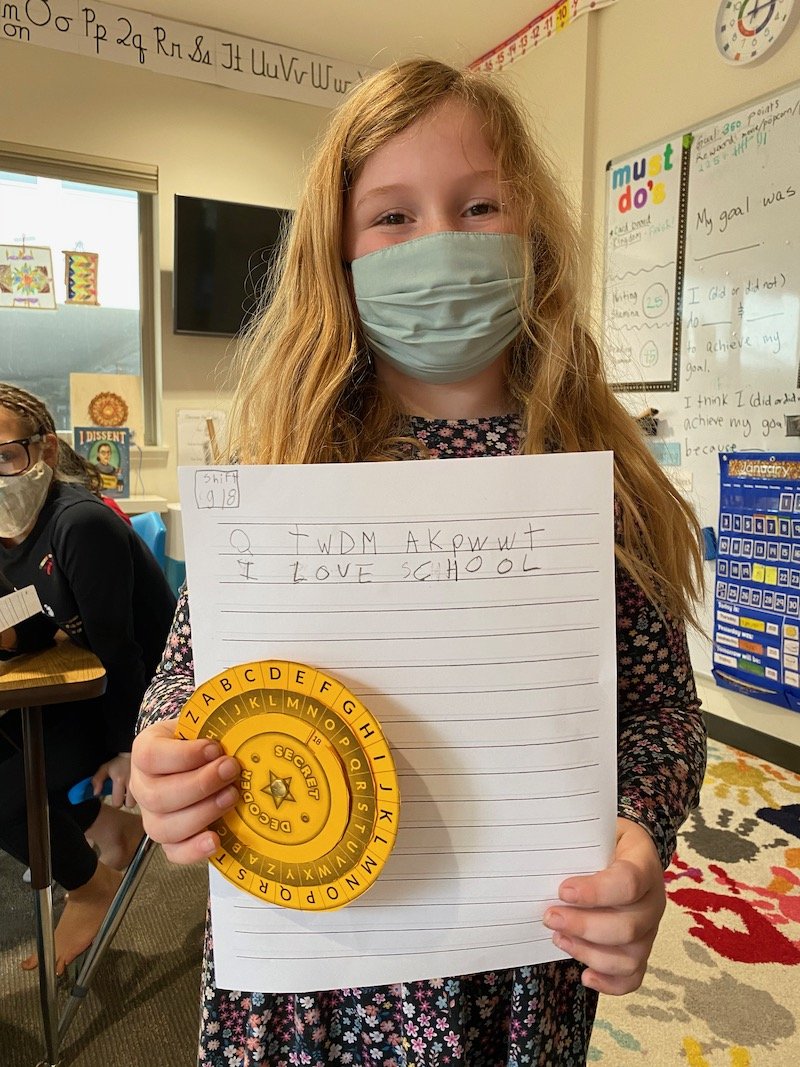
4. In their origin theme students chose a topic to study in depth. Topics in the class varied widely with projects about the origins of service dogs, robotics, ciphers, humans, space travel, and architecture. My daughter choose to study the origin of wheelchairs and created deliverables including a virtual timeline of wheelchair history and improvements, a robotic wheelchair and ramp with a study of safe wheelchair inclines for her robotic wheelchair, mock magazine covers and articles about wheelchairs, a mad-lib about wheelchairs, and a wheelchair pinball 鈥渕achine.鈥� She was noticing wheelchair and accessibility connections in the real world for weeks during this theme!
In working on these projects students spend time working together as a class, break into small groups, and work individually on components that are driven by their own interests and style of learning. As students get older they often get to choose how they want to demonstrate their learning. These projects integrate executive function and academic skills such as time management, organization, note taking, research, typing, learning computer systems, and more.
In addition to school wide project based learning themes students also engage in individual passion projects during intersessions, with their teacher as coach. Two passion project topics my daughter really enjoyed were :

1. Sierpinski triangles where she researched Sierpinski triangles and then decided to hand draw a paper model, make a 3D origami model, and create a 3D model in tinkerCAD and print and assemble. She was able to share all she learned about the topic with her peers.
2. Another intercession passion project she decided to learn to solve a rubix cube - she started with a 2x2 and then a 3x3. It was fun and hard work and is still something she enjoys at home!
In addition to project based learning students also have daily math and language arts, three times per week language classes (Mandarin or Spanish), as well as weekly art, music, and P.E. Math and language arts include differentiated learning - with acceleration and support both offered. Beyond these daily lessons 91视频庐 integrates exciting theme days, field trips, and of course lots of play!
Interested In Learning about admissions?
